Musical → Film: How the 2003 Show Becomes the 2024/2025 Films
The third translation in the funnel. A 2-hour-and-50-minute stage musical becomes a two-part, roughly 5-hour film franchise. The expansion is the story.
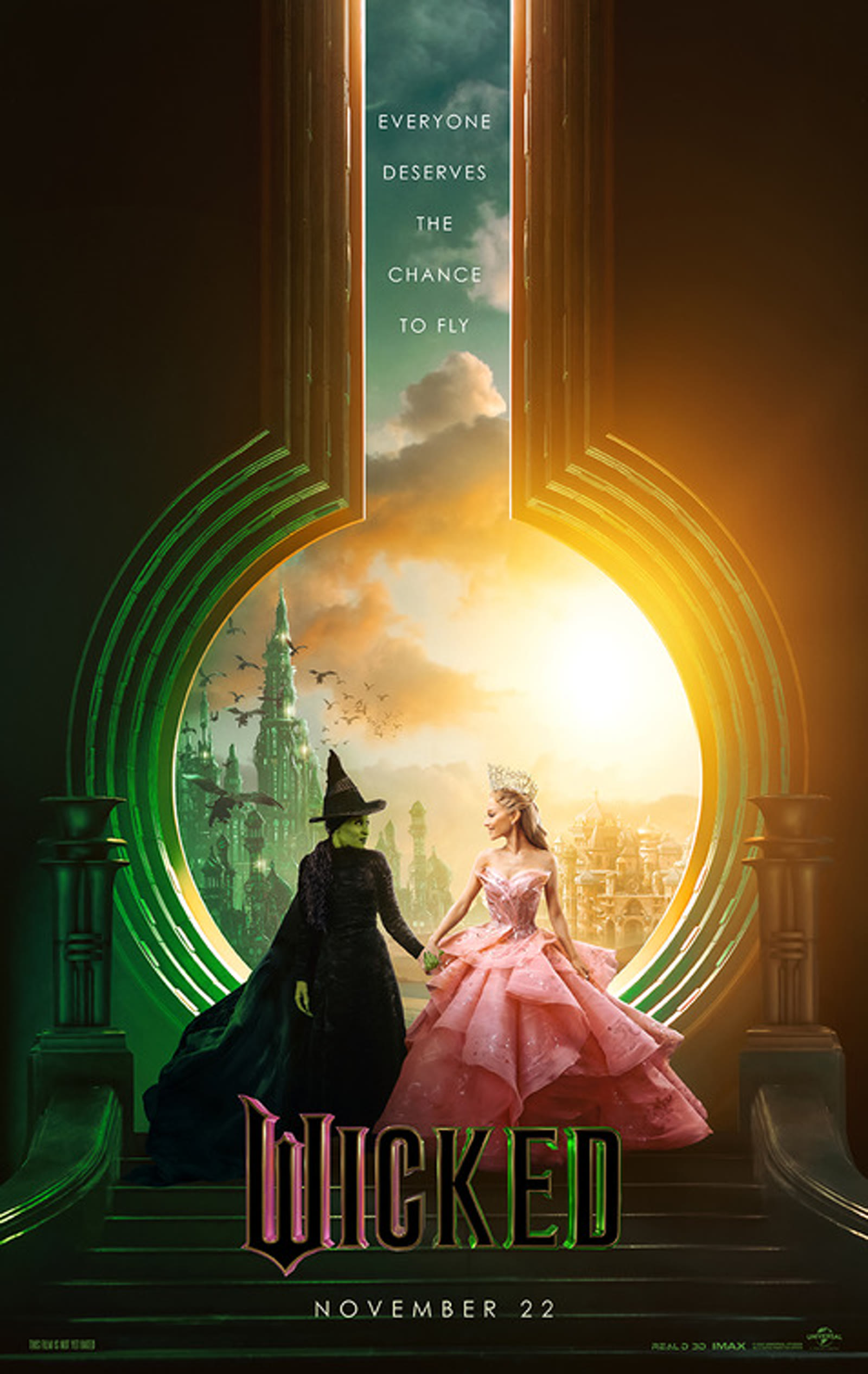
The 25-Year Film Path (1996-2024)
The film rights to Maguire's novel were acquired by Universal in the 1990s, before the stage show existed. For nearly 25 years, the film was in active development:
- Universal acquires film rightsTo Maguire's novel
- Film announced, then deferredThe stage show's success makes a film both more attractive and less urgent
- Serious development beginsUniversal begins planning the film in earnest
- Stephen Daldry attachedDirector of Billy Elliot; December 2019 release targeted
- Delayed for CatsUniversal prioritizes Cats (2019) instead. (Cats is a disaster.)
- Daldry exits; COVIDDaldry leaves over scheduling. Pandemic shuts down everything.
- Jon M. Chu takes overErivo and Grande cast later that year
- ProductionPractical sets at UK stages. Two-part split confirmed.
- Wicked: Part One160 min, $150M budget, $758M box office
- Wicked: For GoodPart Two released November 2025
The Central Adaptation Problem (Reversed)
The book → musical translation compressed: 400 pages became 2 hours 50. The musical → film translation does the opposite: it expands. The 2024 film is 160 minutes — longer than the entire stage musical — and it covers only Act 1.
A stage musical is already compressed for time. Songs are 3-4 minutes; scenes are tight; the whole thing runs under three hours. How do you make a film that is longer than the source, without padding? The answer: go back to Maguire's novel for material the stage show cut, and let the camera show what the stage could only imply.
The Five Film Adaptation Moves
1. The Two-Part Split
The single most consequential decision. Chu pitched Universal on splitting the musical into two films, each covering one act. The reasons:
- Time. The stage musical runs 2h 50m. A faithful single film would have to cut songs to fit a theatrical 2h 20m. Splitting gives ~5 hours total.
- Song preservation. Every song survives. Nothing is reduced to a montage.
- Commercial. Two films = two box office cycles. Universal releases Part 1 in 2024 and Part 2 in 2025.
- Pacing. The stage Act 1 closer ("Defying Gravity") becomes the climax of a full film, not just the end of the first half of a play. This gives the first film a standalone emotional arc.
The trade-off: the audience has to wait a year for the resolution. Universal judged this acceptable (and the 2024 box office confirmed the judgment).
2. Expansion From the Novel
The film does not just film the stage show. It goes back to Maguire's novel for material the musical compressed or cut. Documented additions in the 2024 film:
| Added in the 2024 film | Source |
|---|---|
| Elphaba's childhood in Munchkinland — we see her green skin at birth, her father's rejection, her mother's affair | From Maguire's novel (the musical mentions this only in passing in "No One Mourns the Wicked") |
| The political context of Munchkinland as a contested province | From Maguire's novel |
| Expanded Boq and Nessarose relationship | From Maguire's novel, which gives both characters more interior life than the stage show |
| The Ozdust Ballroom as a developed location (a nightclub "in the underbelly of Oz") | Invented for the film, in the spirit of Maguire's adult Oz |
| Elphaba's bathtub scene in the dormitory — a private moment showing her green skin in water | Film invention, tonally consistent with Maguire's focus on the body |
| More time with the Wizard and Morrible before the reveal | Expansion of stage material |
3. New Songs
Schwartz wrote new songs for both films. This is notable: the film is not a pure adaptation of the stage score, but a re-engagement with it.
Schwartz wrote at least one new song for Part 1, and reworked elements of "No One Mourns the Wicked." The film also uses expanded orchestral arrangements (John Powell co-composing) that give the score a cinematic scale the stage orchestra cannot match.
Three new Schwartz songs were added for the second film. These serve the expanded second-act material — including moments that on stage were spoken or implied.
4. The Visual Re-Design
The stage musical had a specific visual language (Denslow-inspired set, twisted Edwardian costumes, no MGM references). The film invents a new one:

10,000 real roses in the courtyard
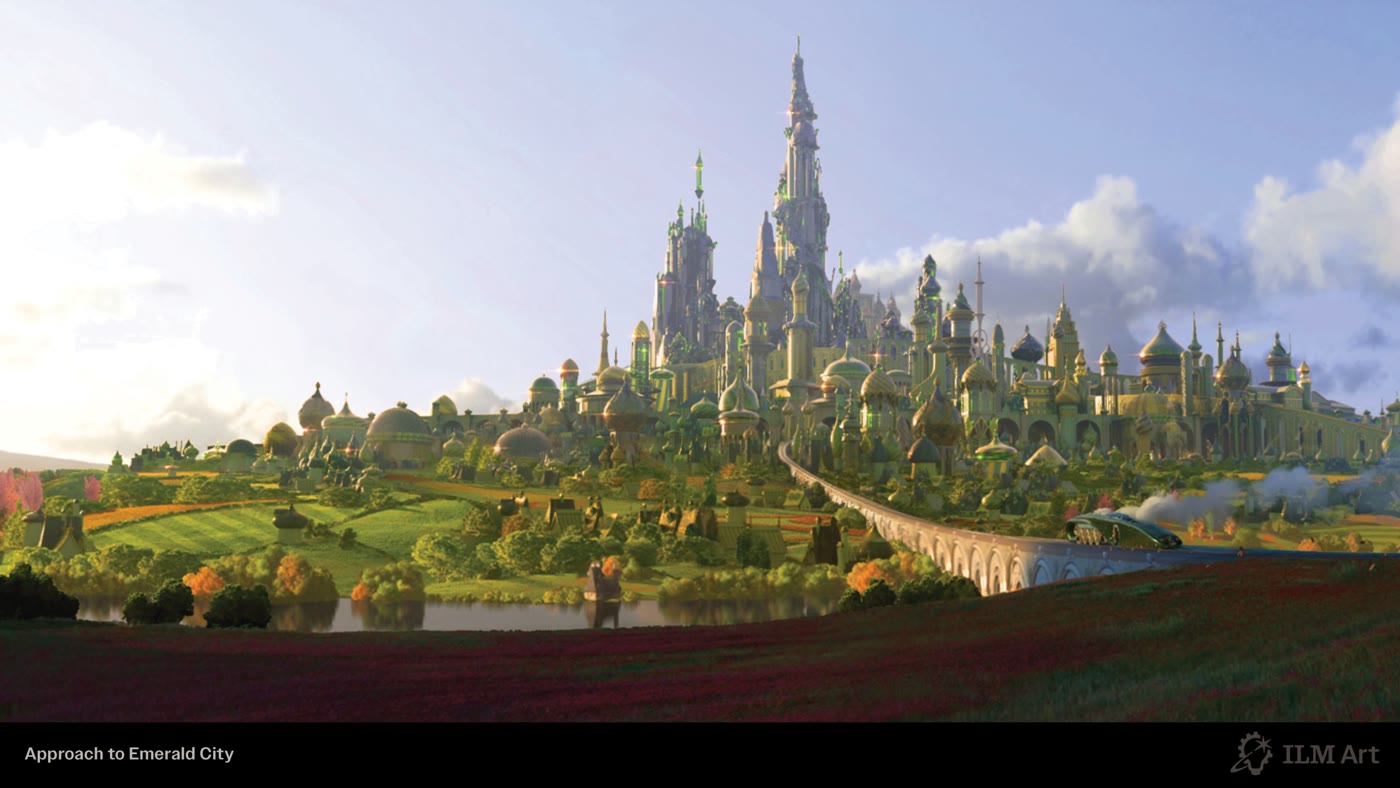
built, not green-screened
- Production design (Nathan Crowley). Massive practical builds — a real Munchkinland, a 10,000-rose Shiz courtyard, the Ozdust Ballroom. The philosophy: build it, don't green-screen it. This is Chu's signature approach from In the Heights.
- Costumes (Paul Tazewell). Drops the stage show's "twisted Edwardian" for a look that includes explicit nods to the 1939 MGM film — which the stage show was legally barred from doing. The film can reference MGM (Universal negotiated the rights). This is a major difference: the film's Oz looks more like the 1939 film's Oz than the stage show's Oz does.
- Cinematography (Alice Brooks). The camera can go where the stage cannot: close-ups of Elphaba's green skin, aerial shots of the Shiz courtyard, the "Defying Gravity" sequence shot from above as Elphaba rises. The stage effect (she flies on a winch) becomes a film sequence (she flies through a real set, shot from multiple angles).
- Elphaba's design (Cynthia Erivo contribution). Erivo contributed Elphaba's micro-braids and full nails — a performer feeding back into the visual design, a small but real example of adaptation flowing bottom-up as well as top-down.
5. Casting as Adaptation
The cast is not just performing the roles; they are reshaping them. Key examples:
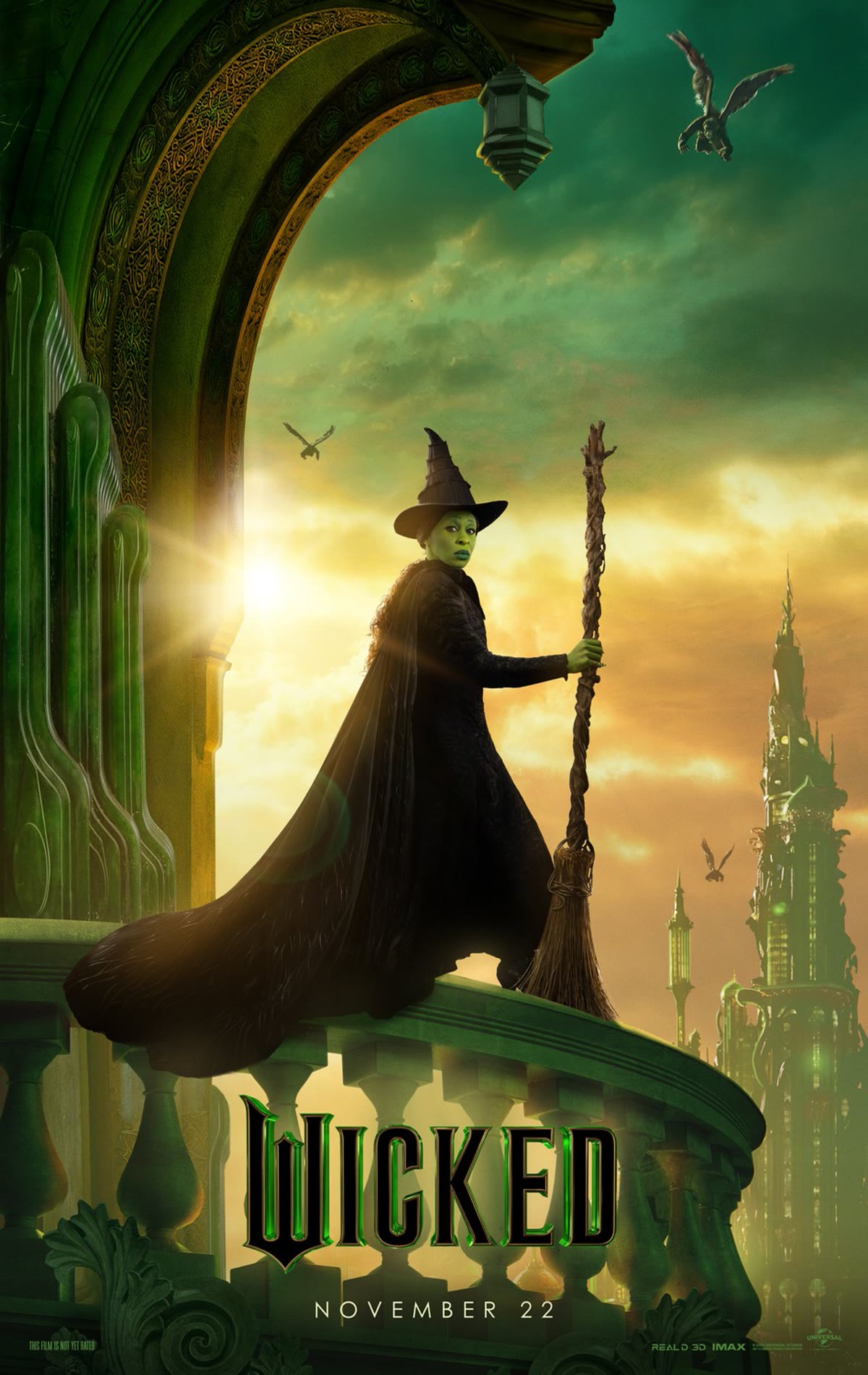
a different vocal color than Menzel's
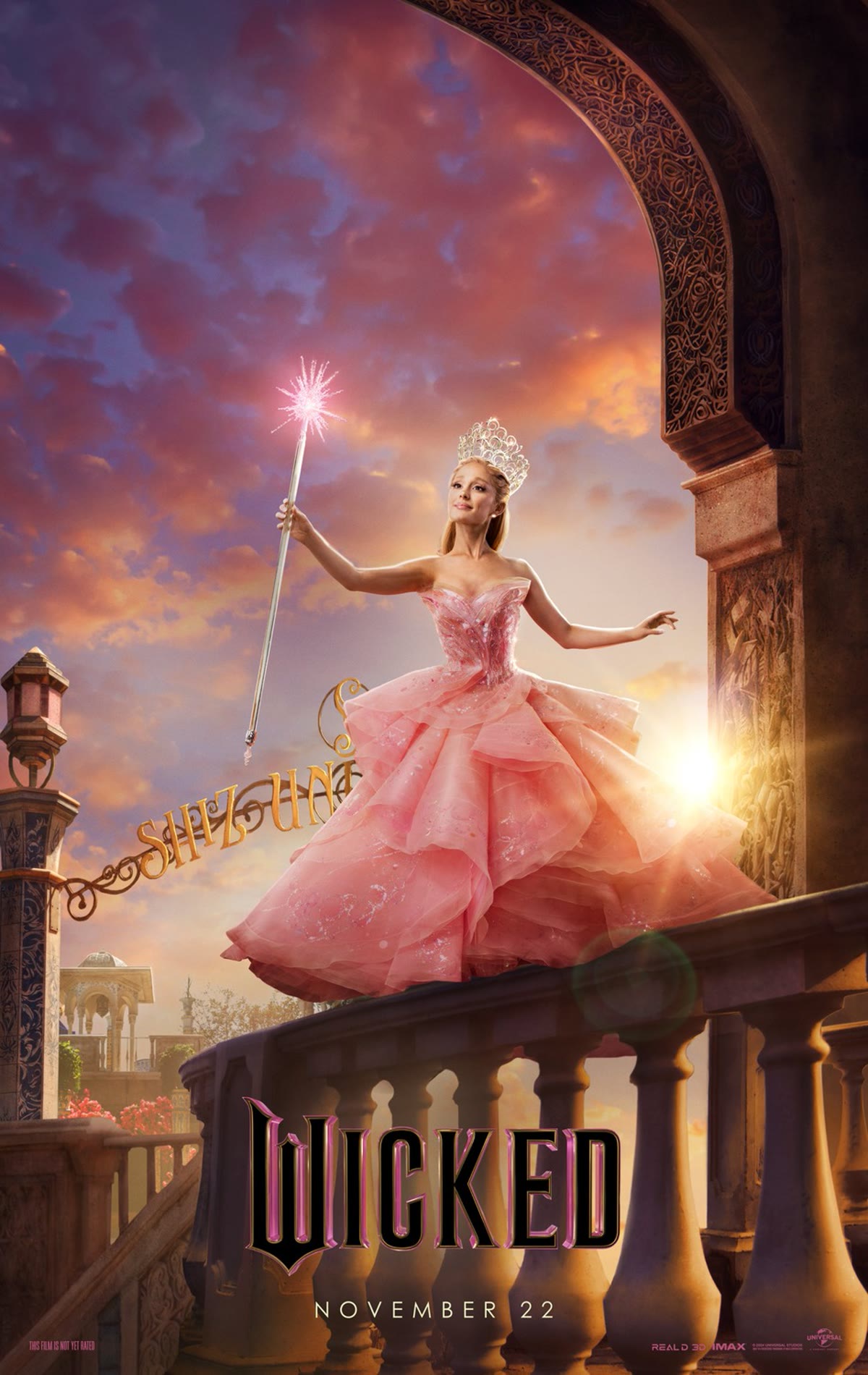
pop-star Glinda, not Broadway-mezzo
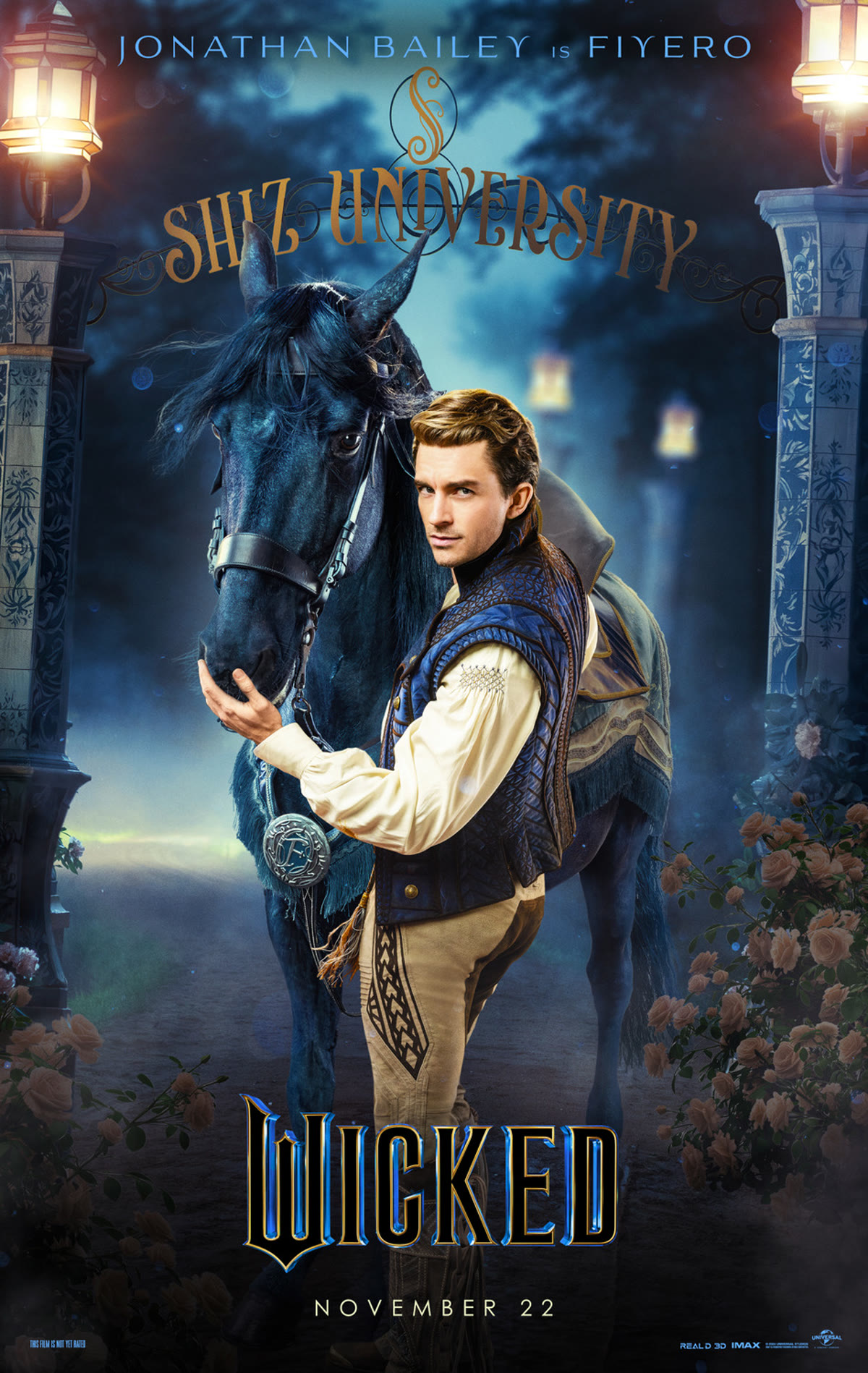
"Dancing Through Life" re-choreographed
| Role | Stage original | Film | Adaptation effect |
|---|---|---|---|
| Elphaba | Idina Menzel (2003) | Cynthia Erivo | Erivo brings a vocal background (live opera and R&B) that gives Elphaba a different vocal color. Her "Defying Gravity" is a different performance than Menzel's, and it is the one a 2024 audience hears. |
| Glinda | Kristin Chenoweth (2003) | Ariana Grande | Grande's pop background shapes Glinda's vocal comedy. The "Popular" number is staged for a pop-star Glinda, not a Broadway-mezzo Glinda. |
| Fiyero | Norbert Leo Butz (2003) | Jonathan Bailey | Bailey brings a musical-theater and dance background (he was in the Company revival). His "Dancing Through Life" is more choreographically demanding than the stage version. |
| Wizard | Joel Grey (2003) | Jeff Goldblum | Goldblum's persona brings a specific, slightly unsettling charm that reads differently than Grey's more theatrical Wizard. |
| Morrible | Carole Shelley (2003) | Michelle Yeoh | Yeoh brings martial-arts film gravitas. Morrible becomes more physically imposing. |
| Dillamond (voice) | William Youmans (2003) | Peter Dinklage | Dinklage's voice carries specific associations (Tyrion Lannister) that color the role of the oppressed Animal professor. |
The film includes cameos by Idina Menzel and Kristin Chenoweth (the original stage Elphaba and Glinda) in the Emerald City scene. This is not just an Easter egg — it is the film explicitly bridging itself to the stage show's history. Winnie Holzman (the stage book writer, who co-wrote the screenplay) and Stephen Schwartz (the composer) also appear. The film acknowledges its own source.
What the Film Keeps From the Stage Show
- The entire score (every song from the stage Act 1 is in the 2024 film, expanded and re-orchestrated)
- The Schwartz/Holzman book structure
- The friendship spine
- The character roster (Elphaba, Glinda, Fiyero, Wizard, Morrible, Dillamond, Boq, Nessarose, Pfannee, Shen Shen)
- Elphaba's survival (the ending change from the novel is preserved)
- "Defying Gravity" as the Act 1 / Film 1 climax
What the Film Changes
- Length. 160 min (Film 1 only) vs. 170 min (full stage show). The film has more time for Act 1 than the stage show did.
- Visuals. A new design language, with MGM references the stage show could not make.
- Songs. New Schwartz songs added to both films, plus expanded orchestration.
- Backstory. Elphaba's childhood is shown on screen (from Maguire's novel), not just sung about.
- Tone. The film can be darker in places (the bathtub scene, the Dillamond removal) and more spectacular in others (the "Defying Gravity" flight). The camera allows a tonal range the stage cannot reach in the same way.
The Net Effect
The film is a re-expansion of the material the stage show compressed — but not a return to the novel's darkness. The film keeps the stage show's happy ending, its friendship spine, and its song structure, while adding back novel material and inventing new songs. It is best understood as a third pass over the same source material: Baum (1900) → Maguire (1995) → Schwartz/Holzman stage (2003) → Schwartz/Holzman/Fox/Chu film (2024/2025). Each pass adds and subtracts; none replaces.
❦
The Full Funnel, Summarized
At each stage, the adapters could see the source. At each stage, they chose what to keep, what to drop, and what to invent. The cumulative result is a property that is recognizably descended from a 1900 children's book, but that none of the original readers — or Baum himself — would have recognized. That is what adaptation is.
The adaptation-theory cross-cut:
Adaptation Theory: the patterns that recur across the whole funnel →