The Pipeline
Every documented date from 1900 to 2025 — the whole chain, in one view. If you read only one page of this guide, read this one.
The Funnel, Year by Year
-
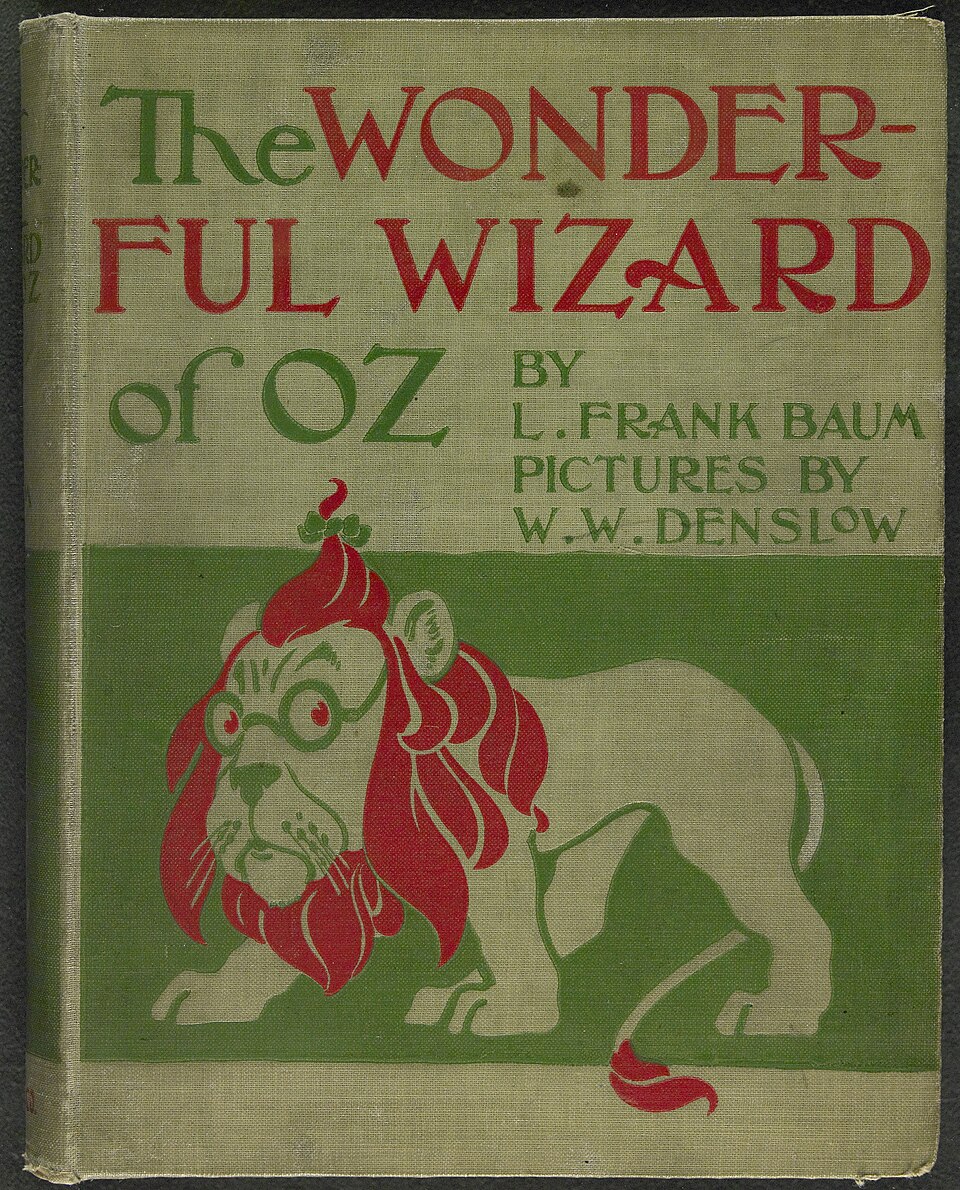
The Wonderful Wizard of Oz published
L. Frank Baum · George M. Hill Company, Chicago · illustrated by W. W. Denslow
The first Oz book. 10,000 copies in the first printing, co-starring a new illustrator (W. W. Denslow) whose drawings were as central to the book's identity as Baum's text. The copyright was registered but not renewed after 28 years — which is why the book enters the public domain in 1956, and anyone can adapt it. This matters: public-domain status is the foundation of the whole downstream chain.
-
First stage adaptation
Baum himself · Broadway at the Majestic Theatre
A musical extravaganza — a loose adaptation, played for comedy. Runs 293 performances. Baum is involved and hates what the producers did to his story. This is the first documented case of the Oz material being adapted to a different medium, and it sets a pattern: every adaptation strips and re-shapes.
-
First film adaptation
Selig Polyscope Company · silent, 13 minutes
A one-reel silent film. Now lost. Baum himself was involved in early film adaptations of Oz, founding the Oz Film Manufacturing Company in 1914. The company failed commercially.
-
First feature-length Oz film
Chadwick Pictures · Larry Semon, director and star
A feature-length silent film — a comedian's vehicle, very loose adaptation. Oliver Hardy (pre-Laurel) appears as the Tin Woodman. This film is notable because its copyright handling later affects whether the 1939 MGM version can use its material.
-
The Wizard of Oz (MGM)
Victor Fleming, director · Metro-Goldwyn-Mayer · Judy Garland, Frank Morgan, Ray Bolger, Bert Lahr, Jack Haley, Margaret Hamilton, Billie Burke
The adaptation that becomes the cultural reference point. Not a hit on initial release ($3 million against a $2.8 million budget — barely breaking even), but its 1956 CBS television broadcast, and then annual network runs from 1959, make it the most-seen film in American television history. The green-skinned Witch, the ruby slippers, the yellow brick road, the tornado, "Somewhere Over the Rainbow" — all MGM's contributions to the visual canon. The film is under continuous copyright (now held by Warner Bros. Discovery via Turner Entertainment).
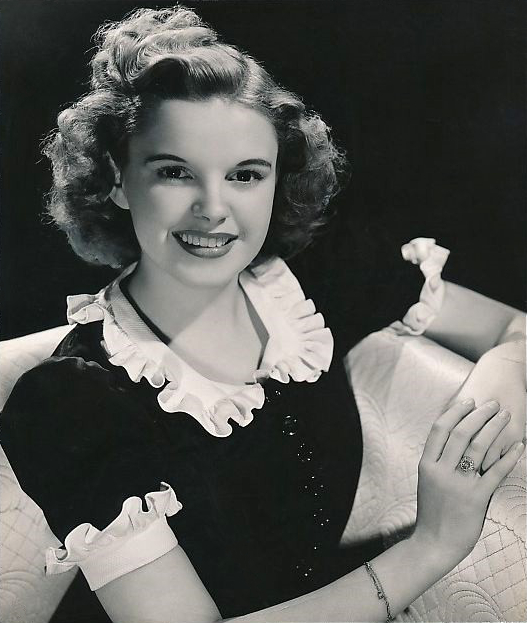 Judy Garland as Dorothy (MGM promotional still, 1939)
 -
Maguire's novel published
Gregory Maguire · ReganBooks / HarperCollins
Wicked: The Life and Times of the Wicked Witch of the West. Maguire takes the 1900 Baum book (now public domain since 1976 in the US due to copyright term) and the 1939 film (still under copyright) as his source. He writes an adult political novel — not a children's book, not a musical. The Witch is sympathetic. The Wizard is a fascist. The novel is a NYTimes bestseller.
-
Film rights interest begins
Universal Pictures
Universal acquires film rights to Maguire's novel. Demi Moore and others are attached to a potential film adaptation. The film track will now run in parallel with the stage track for the next ~25 years.
-
Stephen Schwartz persuades Universal to make it a stage musical
Stephen Schwartz, composer · Marc Platt, producer
The decisive pivot. Schwartz had discovered Maguire's novel on vacation and saw its stage potential. Universal had been planning a live-action film, but Schwartz makes "an impassioned plea" to producer Marc Platt to adapt it as a stage musical first. The film idea is shelved. The stage rights are secured. Winnie Holzman is brought on as book writer.
-
Workshop
Stephen Schwartz, Winnie Holzman · New York
A closed industry workshop of the musical. Stephanie J. Block reads Elphaba. This is where "Which Way is the Party?" is the Fiyero intro song, and where the Act 1 closer "Defying Gravity" is already in place. The workshop exists to test the material in front of producers before the expensive San Francisco tryout.
-
San Francisco tryout
Curran Theatre, May/June 2003
Pre-Broadway engagement. Mixed-to-positive reviews. The tryout surfaces problems: "Which Way is the Party?" isn't landing, and Elphaba is being overshadowed by Chenoweth's showy Glinda. Song is cut. "Dancing Through Life" is written in its place. Elphaba's role is expanded and rebalanced.
-
Broadway opening
Gershwin Theatre, October 30, 2003 · Joe Mantello, director · Wayne Cilento, choreographer · Marc Platt & David Stone, producers
Wicked opens on Broadway. Idina Menzel (Elphaba), Kristin Chenoweth (Glinda), Norbert Leo Butz (Fiyero), Joel Grey (Wizard), Carole Shelley (Morrible). Reviews are mixed (Ben Brantley in the Times is notably harsh), but the box office is strong from the start. The show will run for 20+ years and become the 4th-longest-running Broadway show in history.
-
Original Broadway Cast Album released
Decca Broadway · December 16, 2003 (digital release 2004)
The cast album spreads the score. "Defying Gravity," "Popular," "For Good" enter the karaoke and audition canon. This is how a Broadway show becomes a cultural property that extends beyond theater audiences — the music travels.
-
Universal formally announces film plans
Universal Pictures
After the stage show has run for 8 years and become a global property, Universal begins serious planning on the film adaptation. Stephen Daldry (Billy Elliot) is attached to direct. A December 20, 2019 release is targeted.
-
Film put on hold for Cats
Universal Pictures
Universal prioritizes a different musical adaptation — Cats (2019), directed by Tom Hooper. The Wicked film is delayed. (Cats is a commercial and critical disaster. In hindsight, this is a useful data point about why "same studio, same genre" is not a guarantee of anything.)
-
Daldry exits; COVID-19 delays
Stephen Daldry departs · COVID-19 pandemic
Daldry leaves the project over scheduling conflicts in October 2020. The pandemic shuts down all film production. The Wicked film is now a director-less, undated property.
-
Jon M. Chu attached; Erivo and Grande cast
Jon M. Chu, director (Feb 2021) · Cynthia Erivo as Elphaba, Ariana Grande as Glinda (Nov 2021)
Chu, fresh off In the Heights, takes over. Casting takes most of a year. Grande initially auditions for Elphaba (a miscommunication), then reads for Glinda three times. Other Glinda auditioners include Dove Cameron, Reneé Rapp, and Amanda Seyfried. Chu's pitch to Universal: split it into two films, not one.
-
Production design and pre-production
Nathan Crowley, production designer · Mondo Studio, UK
Production begins building massive practical sets in the UK: a real Munchkinland, a 10,000-rose Shiz courtyard, the Ozdust Ballroom. The design philosophy is practical-build-first, VFX-second. The two-part split is publicly confirmed.
-
Principal photography
Jon M. Chu, director · Alice Brooks, cinematographer · UK stages
Principal photography takes place across 2023 at the UK soundstages. The production uses the same practical-build approach that defined Chu's In the Heights — real sets, real lighting, minimal green screen for the character moments. The Wicked Witch's castle sequence and the "Defying Gravity" climax are the largest set pieces. The film wraps in late 2023.
-
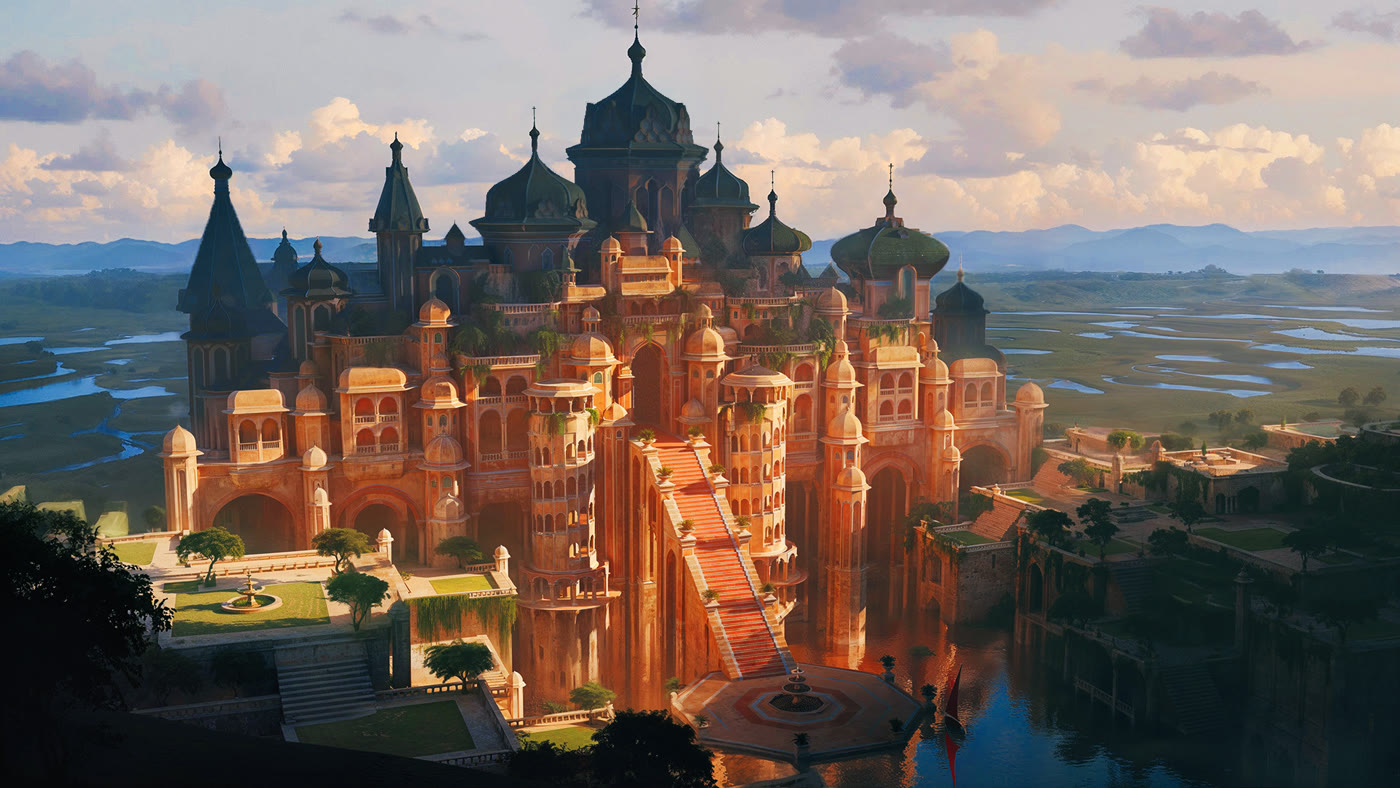
Wicked: Part One released
Universal Pictures · November 22, 2024 (US) · 160 minutes · $150M budget → $758M box office
The first film opens. It covers the first act of the stage musical, expanded with new scenes from Maguire's novel and Schwartz/Holzman's stage book. New songs: "No One Mourns the Wicked" (reworked), and new Schwartz-written songs. Cameos: Idina Menzel and Kristin Chenoweth appear in the Emerald City scene. The film is a commercial smash — the biggest opening weekend ever for a Broadway adaptation.
-
Wicked: For Good (Part Two) released
Universal Pictures · November 21, 2025 (US)
The second film, covering the stage musical's Act II, is released one year later. Three new songs are added, written by Schwartz. The ending — Elphaba's survival, Glinda's arc — is preserved from the stage musical.
Key Inflection Points
Reading the timeline, five points stand out as moments where the whole chain could have gone differently:
If Schwartz does not personally intervene with Platt in 1998 to make it a stage musical first, the property likely becomes a forgettable 2000s live-action film. The stage show never happens. The 2024 film, if it happens at all, is a different film.
If "Which Way is the Party?" is not cut and replaced with "Dancing Through Life," Act 1 has a weaker Fiyero intro. If Elphaba's part is not expanded in the tryout, the show is perceived as "the Kristin Chenoweth show," and the role of Elphaba never becomes the career-defining one that Menzel (and later Erivo) build their careers on.
If Daldry does not exit and Chu does not take over, the film is a different film. Chu's decision to split the story into two parts and to push practical sets over green screen is the design philosophy that distinguishes the 2024 film from a standard VFX-heavy musical adaptation.
In April 2022, Erivo contributes Elphaba's visual design — micro-braids and full nails. This is a small but real case of an actor shaping the character's visual identity beyond the page. It's a good example of how adaptation is not strictly top-down: the performers feed back into the design.
If Universal insists on a single film, major songs are cut or reduced to montage. The two-part split is the reason the 2024 film can be 160 minutes covering only Act 1 — a luxury the stage show never had. It also doubles the box office (two tickets, two years).
Dive deeper into each stage of the funnel: