Book → Musical: How Maguire's Novel Becomes the 2003 Show
The second translation in the funnel. A 400-page adult political novel becomes a 2-hour-and-50-minute Broadway musical. What survives, what dies, and what gets a melody.
The Development Window: 1998-2003
Stephen Schwartz discovered Maguire's novel on vacation, read it, and saw a musical in it. In 1998, he persuaded Universal producer Marc Platt to develop it as a stage musical rather than the live-action film Universal had been planning. Winnie Holzman (My So-Called Life) was brought on as book writer.
The development arc was: option → outline → drafts → 2001 workshop → 2003 San Francisco tryout → 2003 Broadway. Five years from option to opening night. This is typical-to-fast for a major musical.
The Central Adaptation Problem
Maguire's novel is an adult political tragedy covering 40+ years of Elphaba's life, with explicit sex, religious controversy, political assassination, and the death of a child. A Broadway musical is a popular entertainment running under three hours, staged in a single theater, performed eight times a week, aimed at a broad audience including families and tourists. How do you bridge that gap?
The answer Schwartz and Holzman arrived at is the core of the adaptation: compress the timeline to the school years, soften the politics, and make the friendship the spine.
The Six Adaptation Moves
1. Compress the Timeline
Maguire's novel spans Elphaba's whole life: childhood, college, revolutionary years, exile, death. The musical compresses almost everything into the college years at Shiz (Act 1) and a short later period (Act 2). This is the single most important structural decision. It means:
- The friendship between Elphaba and Glinda — which in the novel is one chapter — becomes the central relationship of the whole show.
- The political awakening happens in real time, on stage, rather than being reported across decades.
- The ending (Elphaba's apparent death) lands as the loss of a young woman the audience has watched grow, not the end of a long life.
2. Age the Content Down (Significantly)
The musical strips the novel's adult content systematically:
| In Maguire's novel | In the musical |
|---|---|
| Elphaba has a long-term sexual relationship with Fiyero | Elphaba and Fiyero share a single kiss and a declared love. No sex is depicted or referenced. |
| Elphaba joins a violent revolutionary cell and participates in political assassination | Elphaba's rebellion is magical and symbolic (freeing the monkey, defying the Wizard). No assassination. |
| Elphaba becomes a nun | Elphaba becomes a recluse at Kiamo Ko. No religious vocation. |
| Elphaba has a child (Liir) whose paternity is uncertain | No child. Liir does not appear in the musical. |
| Madame Morrible is murdered | Madame Morrible is imprisoned. |
| Doctor Dillamond is murdered | Doctor Dillamond is fired and later caged, but alive. |
| Nessarose is born without arms | Nessarose is in a wheelchair (a stageable, less visceral disability). |
| Boq becomes the Tin Woodman through a dismemberment/curse subplot | Boq's transformation is referenced but not depicted as graphically. The musical softens it. |
| Elphaba dies (the water kills her) | Elphaba survives — she fakes her death and escapes with Fiyero (as the Scarecrow). This is the biggest plot change. |
3. Make the Friendship the Spine
In the novel, the Elphaba-Glinda friendship is one thread among many. In the musical, it is the central relationship. Schwartz has said this explicitly:
"Primarily we were interested in the relationship between Galinda — who becomes Glinda — and Elphaba... the friendship of these two women and how their characters lead them to completely different destinies."
This is the emotional thesis of the stage show, and it dictates the song structure: "What Is This Feeling?" (loathing), "Popular" (bonding), "Defying Gravity" (separation), "For Good" (reconciliation). The songs track the friendship, not the politics.
4. Find the Songs
The musical invents a score where the novel has prose. This is the largest single act of addition. The major numbers and what they do:
| Song | Position | Adaptation function |
|---|---|---|
| "No One Mourns the Wicked" | Opening | Establishes Glinda's framing and the "wicked" label. Compresses the novel's political prologue into a single song. |
| "The Wizard and I" | Early Act 1 | Elphaba's "I want" song. Gives her an internal life the novel reports but never sings. |
| "What Is This Feeling?" | Act 1 | The loathing song. Establishes the central relationship in three minutes. |
| "Dancing Through Life" | Act 1 | Fiyero's intro. This song replaced "Which Way is the Party?" in the San Francisco tryout — a documented cut that significantly improved the show. |
| "Popular" | Act 1 | Glinda's comic number. The friendship's turning point. Chenoweth's showcase. |
| "One Short Day" | Act 1 | The Emerald City sequence. World-building song. |
| "Defying Gravity" | Act 1 closer | The show's signature number. Elphaba's transformation into the Witch. The stage effect (she flies) is the visual climax of Act 1. |
| "Thank Goodness" | Act 2 opener | Glinda's "I have arrived" song. Establishes the time jump and Glinda's compromised position. |
| "Wonderful" | Act 2 | The Wizard's number. Humanizes him. The "humbug" from Baum, given a song. |
| "As Long as You're Mine" | Act 2 | Elphaba and Fiyero's love duet. Replaces the novel's extended sexual relationship with a single romantic moment. |
| "No Good Deed" | Act 2 | Elphaba's rage aria. The moment she accepts the "Wicked" label. |
| "For Good" | Finale | The friendship duet. The emotional thesis of the show, stated last. |
5. Visual Translation
The novel has no visual identity — it is prose. The musical must invent one, on stage, eight times a week. Key decisions:
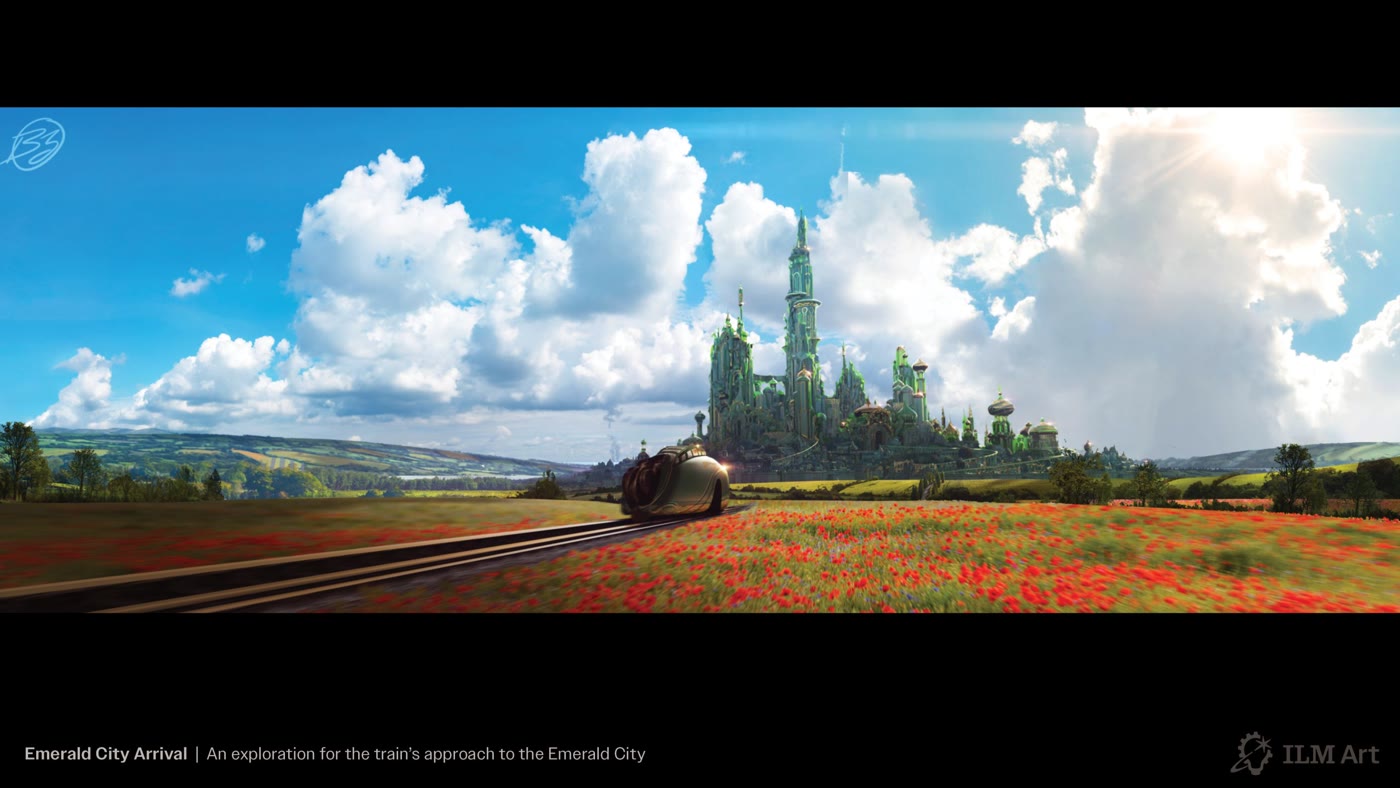
— Denslow-inspired, not MGM
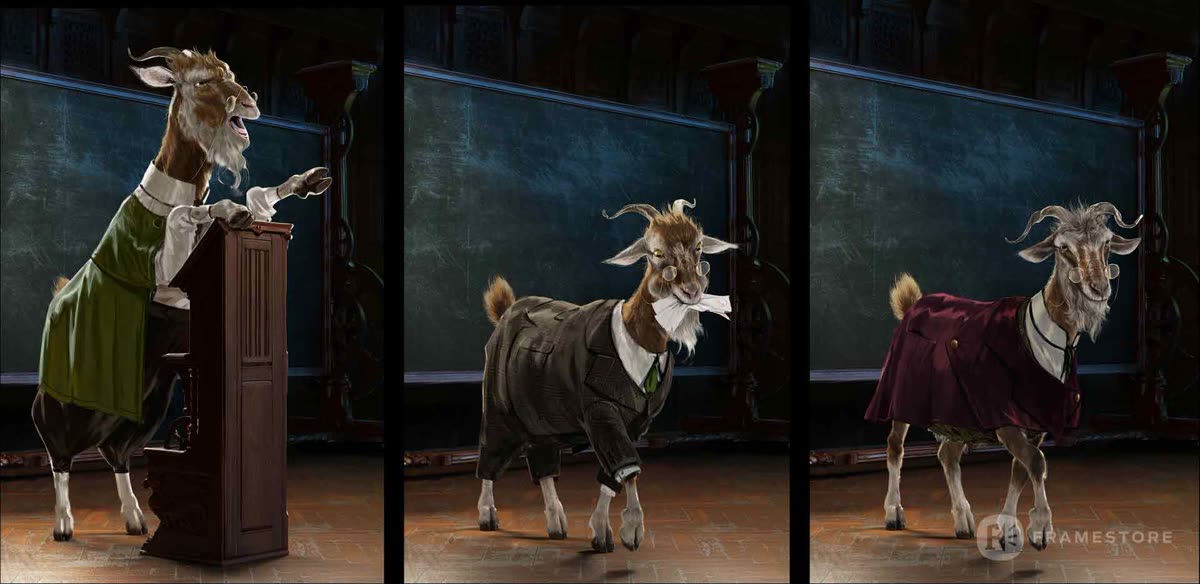
professor, Maguire's invention
- Eugene Lee's set — inspired by Denslow's original 1900 illustrations and a "giant clock" concept. The Clock of the Time Dragon is a framing device borrowed from Maguire but given physical form.
- Susan Hilferty's costumes — "twisted Edwardian." 200+ costumes. Not period, not fantasy, not steampunk — a unique look designed to avoid any visual reference to the 1939 MGM film (which the production was legally prohibited from referencing anyway).
- Kenneth Posner's lighting — 800+ lighting cues for 54 distinct scenes. The lighting is the primary tool for shifting between Oz's locations without set changes.
- Elphaba's green — 40 pots of MAC Chromacake landscape-green makeup per year. The green skin is the visual signature of the property, carried forward from the 1939 film into the stage show.
6. The Tryout Cuts
The San Francisco tryout (May-June 2003) was not the show that opened on Broadway. Two documented changes:
Fiyero's original intro song. Replaced with "Dancing Through Life." The new song is more melodic, more character-specific, and better establishes Fiyero's carefree philosophy. This is the most significant song cut in the show's development.
In the tryout, Kristin Chenoweth's Glinda was dominating the show (Chenoweth is a comic force). The creative team expanded Elphaba's role and gave her more stage time to rebalance. This is an adaptation decision made during previews, based on audience response — a reminder that stage musicals are developed in front of paying audiences, not just in rehearsal rooms.
The Legal Constraint That Shaped the Visuals
The 2003 musical was legally prohibited from referencing any visual element of the 1939 MGM film. The ruby slippers (an MGM invention) could not be used. The film's specific Witch design could not be referenced. The film's musical numbers could not be quoted. This legal constraint forced the musical's creative team to invent an entirely new visual vocabulary for Oz — the "twisted Edwardian" look, the Denslow-inspired set, the clock concept. The constraint produced the aesthetic.
By contrast, the 2024 film can reference the 1939 MGM film (Universal, the film's distributor, negotiated the necessary rights). This is why the 2024 film includes visual nods to the 1939 film — the Kansas dust, the tornado, the ruby slippers — that the stage musical could not. The legal status of the 1939 film shaped both adaptations, in opposite directions.
What the Musical Invents That Is Not in the Novel
The Song Score
The entire score. Maguire's novel has no songs. Schwartz's music is the largest single invention of the stage adaptation.
Elphaba's Survival
In the novel, Elphaba dies. In the musical, she fakes her death and escapes with Fiyero. This is the musical's biggest plot divergence from its source novel — and it is the change that makes the show a popular entertainment rather than a tragedy.
The "Popular" Makeover
The scene where Glinda gives Elphaba a makeover is not in the novel. It is invented for the stage as a comic set-piece and a bonding moment.
The Scarecrow Reveal
The musical's moment where Fiyero is revealed as the Scarecrow is more explicit than in the novel. In Maguire, this is implied in the sequel (Son of a Witch, 2005). The musical stages it as a present-tense transformation.
What the Musical Keeps From the Novel
- The named protagonist (Elphaba) and her green skin
- Shiz University as the setting
- The Animal suppression plot
- The Wizard as political fraud
- Fiyero, Nessarose, Boq, Doctor Dillamond, Madame Morrible
- The Grimmerie
- Kiamo Ko
- The tonal reversal (the Witch is sympathetic)
The Net Effect
The musical is a radical simplification of the novel — but in a specific direction. It keeps Maguire's reversal (the Witch is the protagonist, the Wizard is the villain) and the friendship structure, and it discards almost everything else: the adult content, the political complexity, the moral ambiguity, the novel's length and darkness.
What it adds is melody, visual invention, and a happy ending. This is the standard trade of stage-musical adaptation: trade complexity for accessibility, and tragedy for hope. The 2003 Wicked is a textbook case of this trade, executed at a high level.
Next stage of the funnel:
Musical → Film: How the 2003 show becomes the 2024/2025 two-part film →
The artworks themselves:
/visual/ — The Wicked study guide (show + film)