Places, As the Source Material Maps Them
The geography of Oz is older and stranger than the musical's version of it. Here are the places that matter in the books, the film, and the Maguire novels — including the ones the musical dropped, renamed, or added.
❦
Kansas and the Mortal World
Kansas
In Baum's 1900 book, Kansas is described in a single chapter as a gray, dry, monochrome place. The contrast with Oz is one of color: "When Dorothy stood in the doorway and looked around, she could see nothing but the great gray prairie on every side. Not a tree nor a house broke the broad sweep of flat country that reached to the edge of the sky in all directions." It is a place that needs color, which is what Oz gives it.
The 1939 film expanded this: a working farm, a single house, gray skies, an overworked aunt and uncle. The farm is the framing device — we begin and end in Kansas. The Wicked musical removes the Kansas framing entirely. The story is told entirely from within Oz, and the cyclone that brought Dorothy is heard about, not seen.
Maguire's source: only as the brief off-stage beginning of the 1900 book. Musical: dropped from the narrative.
❦
The Land of Oz
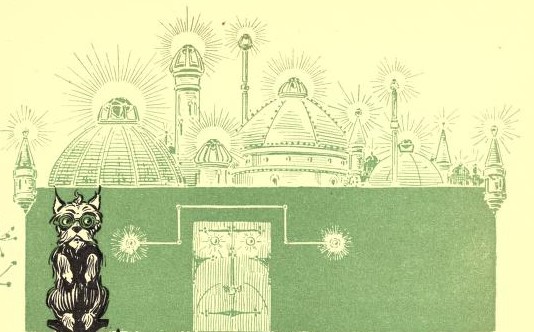
The Emerald City
The capital of Oz, at the center of the country. The city is enclosed by a wall and surrounded by the Emerald City surrounds — a circular region, an ordinary city painted green so that it hurts the eyes to look at. To preserve the illusion, every visitor must wear green spectacles before entering.
The city is run by a succession of rulers: the Wizard (in the 1900 book, until his departure), the Scarecrow (in 1904, until the return of Ozma), and after that Princess Ozma of Oz, with Glinda as the principal political authority. The Wicked musical's Emerald City is a single place in time: the Wizard's Emerald City, with the Scarecrow not yet on the throne and the Wizard still the public power.
Maguire's source: the 1900 Emerald City, the Wizard's court, the spectacle of the place. Musical: the same location, but the Wizard's Emerald City only.
The Yellow Brick Road & The Wilds
The Yellow Brick Road is the path from the eastern Munchkin country to the Emerald City. It is golden-yellow brick, two bricks wide, and runs in a straight line. It is not the only way to get to the Emerald City — there are other paths, but the Yellow Brick Road is the most direct and the most traveled.
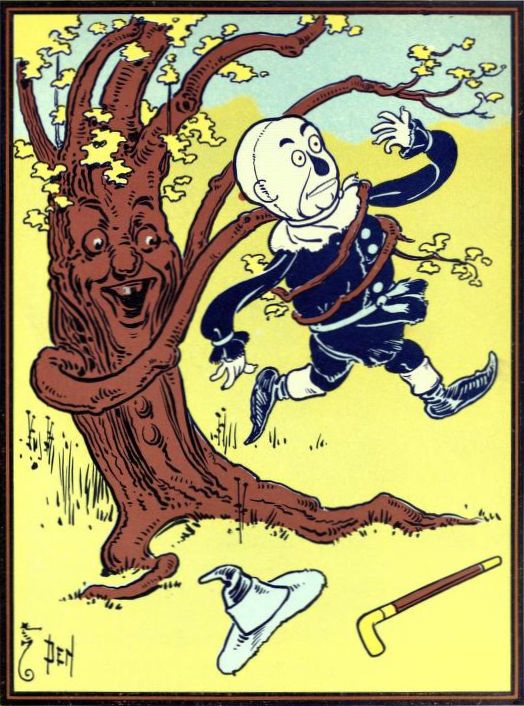
The road in the 1900 book is dotted with obstacles: the field of fighting trees, the dainty china country, the hammerheads, the forest. The 1939 film keeps the forest, the poppy field, the Witch's castle. The Wicked musical keeps the road and the forest but adds Shiz University as a stopping point.
Maguire's source: the road itself, but in Wicked the central journey is Elphaba's, not Dorothy's. Musical: the road as scenic motif, the forest as a place of fear.
Munchkinland
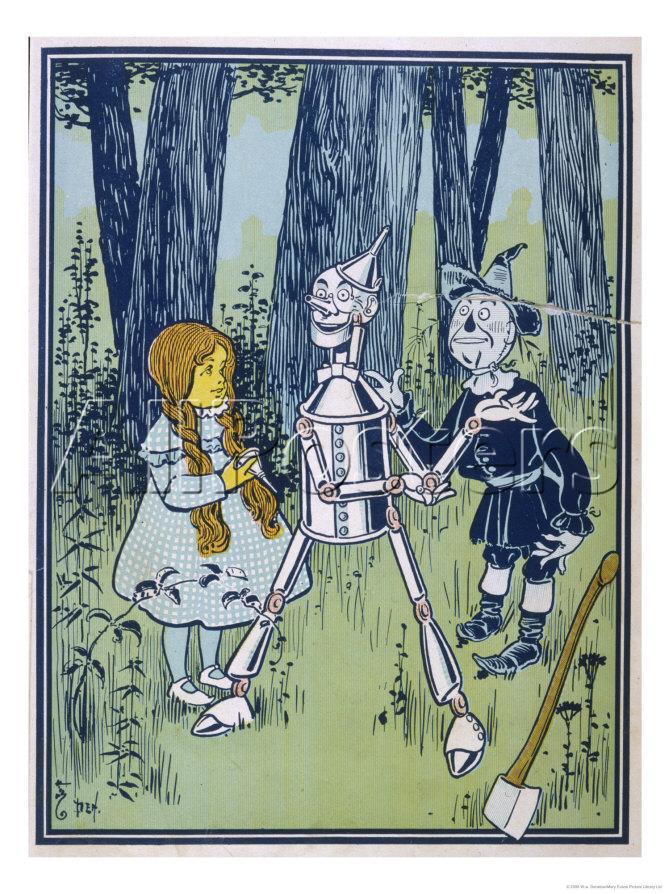
The eastern province of Oz, populated by the Munchkins — small people, cheerful, fond of bright blue clothing. The 1900 book introduces them in the opening chapters; the Wicked Witch of the East is the witch of the Munchkin country. The Wicked musical makes Munchkinland the home of Nessarose and Boq and the governorship of Frexspar (Elphaba's father), drawing on Baum's eastern geography but adding political detail that is Maguire's invention.
Maguire's source: Baum's eastern province, but the political detail (governor, frexspar's mission) is Maguire's invention.
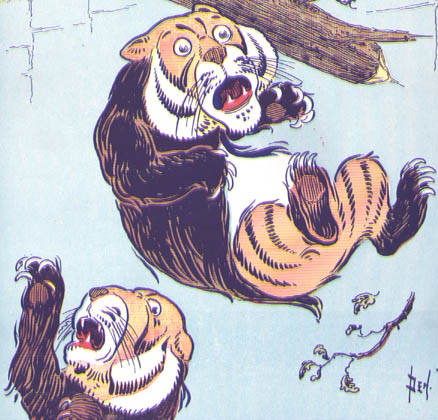
The Wicked Witch's Castle (Kiamo Ko) and the Winkie Country
In the 1900 book, the Wicked Witch of the West lives in a castle in the western province of Oz, the Winkie country, where she rules the Winkies and keeps the Golden Cap that summons the Winged Monkeys. The castle is described as plain stone.
The Winkie country is the only province of Oz whose people are not described as cheerful — they are quiet, watchful, and known for their golden-yellow coloring. They became the basis for Maguire's Winkie country, and Maguire names the Witch's castle Kiamo Ko in Wicked (1995) and expands it into Elphaba's fortress. The Wicked musical keeps the name "Kiamo Ko" and the idea of the castle as Elphaba's lair.
Maguire's source: Book 1. Musical: the name and the political isolation of the castle.
❦
Shiz University (Maguire & Musical Only)
Shiz University
Shiz is a school of magic and politics in Oz. It is not in Baum's books at all. The 1900 Oz has no university; there are very few educational institutions in the original canon. Shiz was invented by Maguire for Wicked (1995) as the place where Elphaba studies, where Fiyero is from, where Madame Morrible teaches, and where Doctor Dillamond is a professor.
The musical keeps Shiz and uses it as the principal setting of Act I. The school is a stand-in for a university — Maguire's drawing on the American/European boarding-school tradition more than on any specific Oz source. It is the most significant single invention of Maguire's that the musical kept.
Source: not from Baum. Invented by Maguire; adopted as the central school setting in the musical.
❦
Other Places Worth Knowing
| Place | First appearance | Significance |
|---|---|---|
| The Dainty China Country | 1900 · Book 1 | Where the road passes through a country of living china figures. The 1939 film does not include it; the musical references it indirectly. |
| The Nome King's Domain | 1907 · Book 3 (Ozma of Oz) | Underground kingdom of the Nome King, accessible through a tunnel from the Winkie country. The tunnels beneath Elphaba's castle in the Wicked Years. |
| The Quadling Country (Glinda's South) | 1900 · Book 1 | Southern province of Oz, where Glinda the Good Witch rules. In the 1939 film renamed to "the South" (the Quadlings are barely shown). |
| Gillikin Country (North) | 1900 · Book 1 | Northern province of Oz, the home of the Good Witch of the North in the 1939 film. |
| The Impassable Desert | 1910 · Book 6 (The Emerald City of Oz) | The barrier Glinda raises to seal Oz from the outside world. The 2024 Wicked film uses this name explicitly for the desert around Oz. |
| Oz's Underground | 1908 · Book 4 (Dorothy and the Wizard in Oz) | Underground network of tunnels and races, including the vegetable people, the wooden Gargoyles, and the Nome kingdom. The source for the underground in Wicked. |
Want the in-universe Wicked locations with concept art?
Our sister study guide has Shiz, Kiamo Ko, the Emerald City arrival, the Ozdust Ballroom, and the rest: Wicked: A Visual Study Guide — Locations.